Malta Solar Market Statistics
PV growth, installed capacity, and market trends across the Maltese islands — updated data on photovoltaic adoption and EU renewable energy targets.
Last updated: 22 November 2026
Malta's Solar PV Sector at a Glance
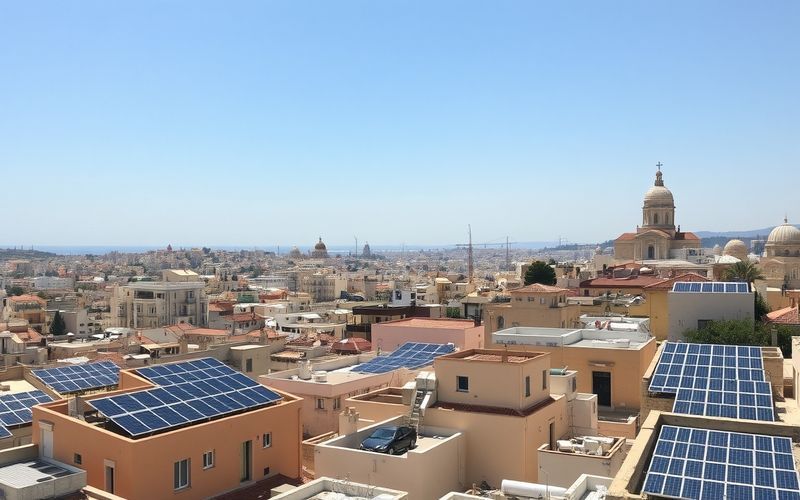
Malta has made remarkable strides in solar photovoltaic adoption over the past decade. Helped by government incentives, falling panel costs, and abundant Mediterranean sunshine, the archipelago now generates a meaningful share of its electricity from rooftop and ground-mounted PV systems.
The typical residential system size ranges from 3–6 kWp, and solar PV supplied roughly 10–11% of Malta's electricity in 2024–2025 (the National Statistics Office put renewables, almost all of it PV, at 10.8% of supply in 2024). At the 2025 annual demand peak (25 July 2025, 636.6 MW) REWS reports that PV met 14.6% of demand. With more than 36,000 PV installations at the end of 2025, Malta has one of the highest per-capita solar adoption rates among small island nations.
Residential vs. Commercial Breakdown
The Maltese solar market is overwhelmingly residential in character. About 93% of installations are domestic, reflecting government grant programmes that have targeted homeowners since the early 2010s. The rest are commercial, industrial, and public-sector installations, including systems on hotels, factories, supermarkets, schools, and government buildings. Commercial systems are larger on average, so their share of installed capacity is higher than their share of installations.
Commercial systems in Malta typically range from 10 to 100 kWp, though a small number of larger installations exceeding 200 kWp have been deployed on industrial estates and logistics facilities. The commercial segment has been growing as businesses seek to reduce electricity costs, meet corporate sustainability goals, and earn the feed-in tariff or competitive-bidding contracts for exported generation.
Year-by-Year Capacity Growth
The table below shows how Malta's cumulative installed PV capacity has grown in recent years, using National Statistics Office year-end figures.
| Year | Annual Additions (MW) | Cumulative Capacity (MW) | Notable Developments |
|---|---|---|---|
| 2022 | — | ~221 | Energy crisis boosts self-generation |
| 2023 | ~20 | ~241 | Continued strong rooftop uptake |
| 2024 | ~11 | ~252 | 34,955 installations recorded |
| 2025 | ~16 (NSO totals; REWS reports 14.1 gross) | ~268 | 36,243 installations recorded |
Data to end-2025. Source: NSO Malta, Renewable Energy from Photovoltaic Panels 2025 (released 23 June 2026). Earlier years are omitted because we could not verify them against NSO releases. Annual additions are the difference between NSO year-end totals.
Annual additions slowed from about 20 MWp in 2023 to about 11 MWp in 2024 before recovering to about 16 MWp in 2025. The European energy crisis of 2022 increased interest in self-generation, as households and businesses looked to insulate themselves from volatile electricity prices.
Market Drivers & Growth Factors
Policy & Incentive Support
Malta's government has consistently supported solar PV through a combination of capital grants and feed-in tariffs. The residential grant programme, which paid up to €3,000 towards a PV system in 2026, has been a primary driver of adoption, although the 2026 call closed in September. Feed-in tariffs guarantee a fixed rate for exported electricity (€0.15 per kWh for 20 years on systems under 40 kWp without a grant), providing long-term revenue certainty to system owners. Net metering is closed to new connections.
Falling Technology Costs
The global decline in solar costs — the levelised cost of solar PV electricity is down about 89% since 2010 (IRENA) — has made PV systems increasingly affordable for Maltese households and businesses. System prices vary by installer and roof, and we found no official Malta price series, so get several quotes. Payback depends on how much of the output you use yourself.
Exceptional Solar Resource
Malta receives approximately 3,000 hours of sunshine per year, making it one of the best locations in Europe for solar energy. A well-oriented PV system in Malta produces roughly 1,650 kWh per installed kWp annually (PVGIS gives about 1,670 at an optimal tilt), well above typical northern European yields.
Energy Security Concerns
As a small island nation heavily dependent on imported energy, Malta has a strong strategic interest in expanding domestic renewable generation. Solar PV helps reduce reliance on the gas-fired Delimara power station and the Malta-Sicily interconnector, improving energy resilience.
Solar: Malta's Dominant Renewable
Solar PV accounts for about 97% of Malta's renewable electricity (NSO, 2024). With limited wind and no hydro resources, photovoltaics are the clear technology of choice for the Maltese islands.

Malta & EU Renewable Energy Targets
Under the EU's Renewable Energy Directive, Malta has committed to increasing its share of renewable energy. While Malta's overall renewable share remains among the lowest in the EU due to limited wind and hydro resources, solar PV is by far the dominant renewable technology on the islands.
Malta's National Energy and Climate Plan (NECP), updated in December 2024, sets a 2030 renewable share contribution of no less than 25% of gross final energy consumption (the plan projects 24.5%) and a pathway for continued solar deployment. However, the archipelago faces unique challenges: limited land area, roof space constraints, grid capacity limitations, and planning restrictions in heritage zones. Achieving higher penetration will require innovation in areas such as battery storage, building-integrated PV, and potentially offshore floating solar.

Market Outlook & Forecasts
The Maltese solar market is expected to continue growing, though at a moderating pace as the most accessible rooftop sites are utilised. Further growth depends on consistent policy support and on grid upgrades to accommodate more distributed generation. Key trends shaping the market include:
- Battery storage integration: Increasingly paired with PV systems to maximise self-consumption. According to REWS figures reported by MaltaToday, small-scale battery capacity roughly doubled in 2025, to about 3,150 installations and 31.6 MWh.
- Commercial & industrial growth: Larger rooftop and car-park canopy systems for businesses, hotels, and industrial estates.
- Building-integrated PV: Solar tiles and facade-mounted panels for heritage-sensitive areas where traditional panels are restricted.
- Community energy projects: Shared solar schemes allowing apartment dwellers and renters to benefit from PV, such as Pannelli bla Bejt, launched in April 2026.
- Smart grid development: Grid modernisation to handle higher levels of distributed solar generation.
Challenges Facing the Market
Despite strong fundamentals, Malta's solar sector faces several constraints that could slow future growth. The most significant is limited roof space. As a densely built archipelago with a high proportion of multi-storey apartment buildings, many properties lack sufficient unshaded roof area for a viable PV installation. Heritage protection rules in areas such as Valletta, Mdina, and the Three Cities further restrict where panels can be placed. Grid congestion is another growing concern, as the distribution network in some areas approaches its capacity to absorb additional distributed generation during peak solar hours.
Addressing these challenges will require a combination of technological innovation, regulatory flexibility, and infrastructure investment. Higher-efficiency panels that generate more power per square metre, building-integrated solutions that blend with traditional Maltese architecture, and battery storage systems that shift surplus generation to evening demand peaks will all play a role in unlocking the next phase of Malta's solar growth.
For a detailed look at what lies ahead, visit our Future Outlook page. If you are considering installing solar panels, our Going Solar guide walks you through every step of the process.
For what a single home system makes month by month, see the seasonal production chart, built on PVGIS data for Malta and Gozo.