Malta Solar Energy Future — 2030 Outlook & Emerging Technologies
Malta's solar energy sector is poised for significant growth as the country races to meet EU renewable targets. From perovskite cells and building-integrated PV to smart grids and electric vehicles, the next decade will reshape how Malta generates, stores, and consumes energy.
Last updated: 22 November 2026
Malta's 2030 Renewable Energy Targets
Under the EU's revised Renewable Energy Directive and Malta's National Energy and Climate Plan (NECP), the country's updated plan (submitted in December 2024) sets a contribution of no less than 25% of gross final energy consumption from renewables by 2030. Although still modest by EU standards (reflecting Malta's unique constraints), it is a substantial increase from the 17.2% reached in 2024 and the provisional 18.8% for 2025.
Why is it so challenging?
Malta's relatively modest RES target reflects the country's severe land constraints, small grid size, and limited potential for hydroelectric or onshore wind energy. Unlike larger EU members that can deploy gigawatts of onshore wind and large-scale solar farms, Malta must achieve its renewable growth primarily through distributed rooftop solar, making each percentage point of progress harder to achieve per square kilometre of territory.
Projected Solar Capacity Growth
Solar PV is expected to be the primary driver of Malta's progress toward its 2030 target. Installed capacity was about 268 MWp at the end of 2025 and will need to keep growing. The main sources of new capacity are likely to be:
- Rooftop solar: Continued deployment on residential, commercial, and public buildings is expected to remain the main source of new capacity, driven by government incentive schemes and declining panel costs.
- Ground-mounted and floating solar: New utility-scale projects on brownfield sites, car parks, quarries and water bodies could add to this. A 3.5 MWp solar farm on a former quarry started operating in May 2026, while a proposed 50 MW floating PV plant off Delimara drew 13 proposals, which are under evaluation by an expert committee, with no award found.
Achieving this growth will require sustained government support, streamlined permitting processes, and continued investment in grid infrastructure to manage higher levels of variable renewable generation.
Emerging PV Technologies
The solar panels installed in Malta today are overwhelmingly conventional crystalline silicon modules. However, several emerging technologies could significantly expand where and how solar energy is harvested in Malta's dense urban environment.
Perovskite Solar Cells
Perovskite photovoltaic cells are the most promising emerging solar technology. These cells use a class of synthetic crystalline materials with a perovskite crystal structure that can be manufactured at low temperatures using printing or coating processes, potentially at much lower cost than silicon.
Key advantages for Malta include:
- High efficiency potential: Perovskite-silicon tandem cells have achieved laboratory efficiencies above 35%, surpassing the practical limits of silicon alone.
- Flexibility: Perovskite cells can be deposited on flexible substrates, enabling lightweight, bendable solar products suited to surfaces where rigid glass panels cannot be installed.
- Tuneable transparency: The optical properties of perovskites can be adjusted to create semi-transparent cells for window applications.
- Low-light performance: Perovskites perform well in diffuse and low-angle light conditions, maintaining output during Malta's milder winter months.
Challenges including long-term stability, moisture sensitivity, and the use of lead-based compounds remain active areas of research. Commercial perovskite modules are expected to reach the market at scale in the late 2020s.
Building-Integrated Photovoltaics (BIPV)
BIPV products replace conventional building materials — facades, windows, roof tiles, balustrades, and shading elements — with solar-generating alternatives. For Malta, where heritage regulations and aesthetic concerns can restrict conventional panel installations on visible facades and in historic areas, BIPV offers a pathway to deploy solar on surfaces currently off-limits.
Promising BIPV applications for Malta include:
- Solar roof tiles: Terracotta-coloured solar tiles that blend with traditional Mediterranean roofing styles, enabling solar generation on heritage and conservation-area buildings.
- Facade-integrated panels: Thin-film or coloured PV modules integrated into building facades, generating electricity from vertical surfaces that receive significant irradiance during morning and evening hours.
- Solar shading devices: PV-integrated louvres and brise-soleil that simultaneously generate electricity and reduce cooling loads — a compelling dual benefit in Malta's hot climate.
- Solar balustrades: Glass-glass PV modules replacing conventional balcony railings, harvesting energy from surfaces that are typically wasted.
Transparent Solar
Transparent photovoltaic technology uses organic or perovskite-based materials to selectively absorb ultraviolet and infrared light while allowing visible light to pass through. These technologies are being developed for integration into windows, skylights, and glass facades.
While current transparent solar efficiencies are modest (5–10%), the vast area of glass surfaces on Malta's commercial buildings represents a significant untapped energy resource. As the technology matures, transparent solar could turn every office tower, hotel, and shopping centre window into a power-generating surface.
Smart Grid Development
As solar penetration increases, Malta's electrical grid must evolve from a traditional one-way system (power stations to consumers) into a smart grid capable of managing thousands of distributed generators, variable renewable output, and increasingly flexible demand.
Smart Meters and Data
Enemalta has been progressively rolling out smart electricity meters across Malta, replacing legacy meters with digital devices that provide real-time consumption data, enable time-of-use tariffs, and support remote monitoring. Smart meters are a foundational technology for the smart grid, providing the data layer needed to manage a complex, distributed energy system.
Grid Management and Automation
Key smart grid capabilities being developed or planned for Malta include:
- Advanced distribution management systems (ADMS): Software platforms that monitor and control the low-voltage network in real time, managing voltage fluctuations caused by high solar feed-in from rooftop systems.
- Dynamic line rating: Using real-time weather and temperature data to optimise the capacity of existing power lines, potentially deferring expensive grid upgrade investments.
- Automated fault detection: Smart sensors and switches that detect faults and reroute power automatically, reducing outage duration and improving reliability.
- Demand-side response: Programmes that incentivise consumers to shift electricity use to periods of high solar generation (e.g., running appliances during midday), flattening the demand curve and reducing curtailment.
Electric Vehicles and Vehicle-to-Grid (V2G)
The electrification of transport is accelerating globally, and Malta — with its short driving distances, urban traffic congestion, and growing charging infrastructure — is well-positioned for rapid EV adoption. The intersection of EVs and solar energy creates powerful synergies.
Solar-Powered EV Charging
Pairing rooftop solar with home EV charging allows Maltese households to charge their vehicles directly from sunshine, reducing both electricity costs and carbon emissions. With typical daily driving distances in Malta under 30 km, a modest 3–5 kWp rooftop system can generate enough energy to cover most household driving needs, effectively providing free fuel for the life of the solar system.
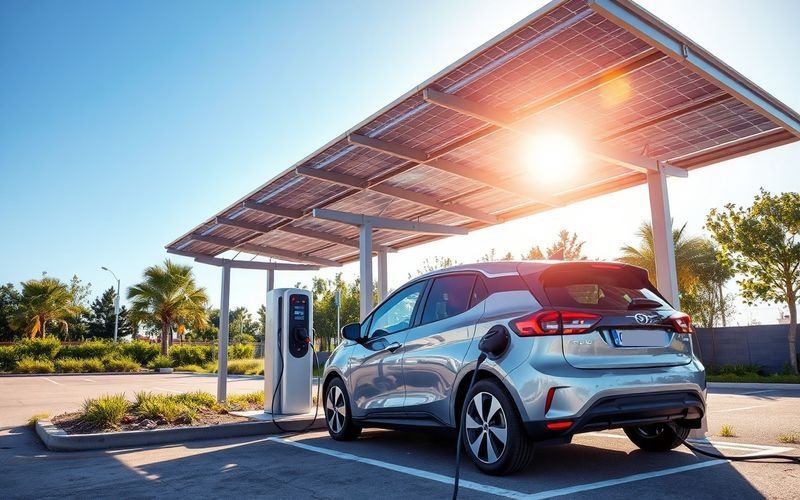
Public and workplace solar car port charging stations — where PV canopies over parking areas feed directly into EV chargers — are already appearing in Malta and expected to grow rapidly.
Vehicle-to-Grid (V2G)
V2G technology enables electric vehicles to feed stored energy back into the grid during periods of high demand, effectively turning each EV into a mobile battery storage unit. For Malta, where grid-scale battery storage is expensive and space-constrained, a fleet of V2G-capable EVs could provide significant distributed storage capacity.
Consider the potential: if Malta reaches 50,000 EVs (a plausible target for the early 2030s), each with a 50 kWh battery and 10 kWh available for V2G services, the aggregate storage capacity would be 500 MWh — far more than any dedicated battery installation likely to be built on the islands. This fleet could absorb surplus solar generation during the day and release it during evening demand peaks, dramatically improving the value and usability of Malta's growing solar capacity.

Energy Communities
The EU's Clean Energy for All Europeans legislative package introduced the concept of Renewable Energy Communities (RECs) and Citizen Energy Communities (CECs), enabling groups of citizens, local authorities, and small enterprises to collectively generate, consume, store, and sell renewable energy.
For Malta, energy communities could address one of the key barriers to solar adoption: the large number of residents who live in apartments, terraced houses, or buildings with shared or unsuitable roofs. Through energy communities, these residents can invest in shared solar installations and receive a proportional share of the generated electricity, credited against their bills.
Potential models for Maltese energy communities include:
- Block-level communities: Residents of an apartment block collectively installing solar on the shared roof and distributing benefits according to investment shares.
- Neighbourhood communities: Multiple buildings sharing a medium-scale solar installation on a nearby car park, public building, or community centre roof.
- Local authority-led communities: Local councils facilitating community solar projects on municipal land or buildings, with residents subscribing to output shares.
- Virtual communities: Geographically dispersed participants sharing the output of a centrally located solar installation through grid credits and digital platforms.
A first practical example is Pannelli bla Bejt, launched by the Water Services Corporation in April 2026, in which households without a suitable roof buy a share of panels installed on WSC sites. Malta's wider regulatory framework for energy communities is still developing, but enabling legislation aligned with the EU directives is expected to stimulate this model significantly in the coming years.

Green Hydrogen Potential
Green hydrogen — hydrogen produced by electrolysis of water using renewable electricity — is increasingly seen as a key component of the European energy transition, particularly for decarbonising sectors that are difficult to electrify directly (heavy industry, shipping, aviation).
Malta's potential role in the green hydrogen economy is modest but not negligible:
- Surplus solar conversion: As solar penetration increases, there will be periods when generation exceeds grid demand and export capacity. Converting this surplus electricity to hydrogen via electrolysis could provide a form of long-duration energy storage, storing summer solar energy for use in winter or during extended cloudy periods.
- Maritime decarbonisation: Malta's status as a major shipping hub and flag state creates potential demand for green hydrogen and its derivatives (ammonia, methanol) as marine fuels. Port-based electrolysis powered by solar and grid electricity could serve this emerging market.
- Gas grid blending: Small quantities of hydrogen could potentially be blended into Malta's natural gas distribution network, reducing the carbon intensity of gas heating and cooking.
However, green hydrogen production is energy-intensive (requiring approximately 50–55 kWh of electricity per kg of hydrogen) and Malta's limited renewable generation capacity may be better used for direct electricity consumption in the near term. Green hydrogen is likely a longer-term opportunity for Malta, becoming more relevant as solar capacity grows and electrolysis costs decline.
Key Challenges Ahead
Grid Stability
As solar PV provides an increasing share of Malta's electricity, managing grid stability becomes progressively more complex. Solar generation is inherently variable (clouds, nightfall) and does not match demand patterns. High solar penetration can cause voltage fluctuations, reverse power flows, and frequency deviations on a small island grid. Solutions include smart inverters, battery storage, demand-side management, and optimised use of the interconnector.
Energy Storage
Without adequate storage, the value of solar generation diminishes as penetration increases (the "solar value deflation" problem). Malta needs significant investment in battery storage at both household and grid scale to shift solar energy from daytime generation to evening demand peaks. The cost of lithium-ion batteries continues to fall, but Malta must also explore longer-duration storage options for multi-day and seasonal balancing.
Space Constraints
Even for rooftop solar, Malta faces growing constraints. Many of the most suitable rooftops have already been equipped with panels, and remaining potential includes more challenging sites (shaded roofs, heritage buildings, structurally limited structures). BIPV, floating solar, and agrivoltaics will be needed to access new surfaces and sites.
Grid Infrastructure Upgrades
Malta's low-voltage distribution network was designed for one-way power flow from central generators to consumers. High levels of distributed solar generation create reverse power flows that can overload transformers and cables. Significant investment in network reinforcement, smart grid technology, and a second interconnector will be required. That 225 MW link to Sicily has an EIB loan of €100 million signed in April 2026, with no confirmed operation date.
Workforce and Skills
A growing solar sector requires a skilled workforce of installers, electricians, engineers, and energy consultants. Malta must invest in vocational training and education programmes to ensure that the domestic workforce can support accelerating deployment without quality or safety compromises.

Policy Roadmap
Malta's government has outlined a series of policy measures to support the country's solar and renewable energy growth through 2030 and beyond:
- Incentive schemes: The 2026 household grant call closed on 12 September 2026 and no new call has been announced. The feed-in tariff continues. Budget 2027 was presented on 26 October 2026; press summaries report that existing annual schemes are renewed for 2027, but the official text is unverified, so confirm with REWS.
- Building regulations update: Strengthening of Nearly Zero Energy Building (NZEB) requirements to mandate solar integration in new construction and major renovations.
- Energy community framework: Full transposition of EU energy community legislation into Maltese law, enabling collective solar schemes and neighbourhood-level energy sharing.
- EV infrastructure plan: National deployment plan for public and private EV charging infrastructure, with requirements for solar-ready and V2G-capable installations.
- Grid modernisation investment: Multi-year capital programme by Enemalta to upgrade distribution network capacity, deploy smart grid technologies, and prepare for higher renewable penetration.
- Research and innovation: Support for solar technology R&D through the University of Malta's Institute for Sustainable Energy and participation in EU-funded research programmes such as Horizon Europe.
- Marine spatial planning: Development of a comprehensive marine spatial plan that identifies potential zones for offshore renewable energy deployment while protecting marine ecosystems and existing maritime uses.
The Big Picture
Malta's energy future is being shaped by the convergence of falling solar costs, EU decarbonisation mandates, emerging storage technologies, and transport electrification. While the island's small size and dense population create unique challenges, they also mean that relatively modest absolute investments can have transformative impacts on the national energy system. The next decade will be decisive in determining whether Malta can leverage its abundant sunshine into a genuinely sustainable energy future.