DIY Solar in Malta
You can do far more of a solar installation yourself than most people think — but not everything is legal to self-connect in Malta, and DIY changes your grant. Here is the honest, safety-first picture.
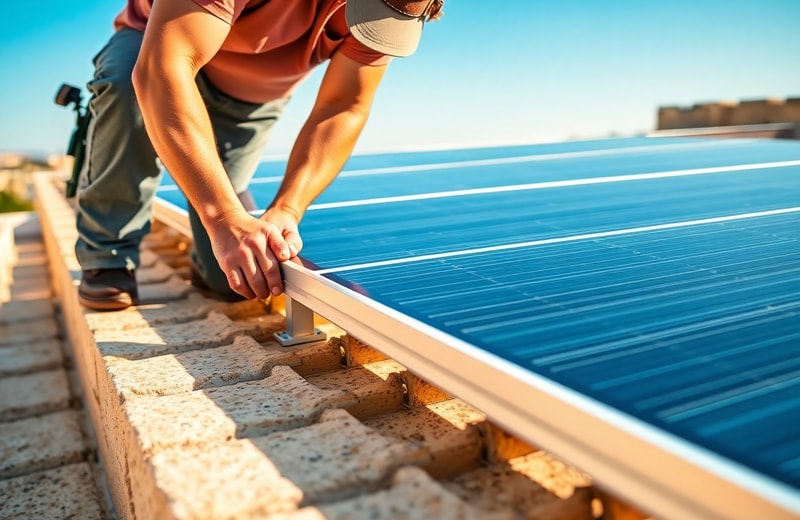
Last updated: 22 November 2026
You can do far more of a solar installation yourself than most people in Malta assume — the survey, the sizing, the mounting, even much of the DC wiring. What you cannot legally do is self-certify or self-connect a grid-tied system, and going the DIY route changes your grant. This is a safety-first guide, not a "solar is easy" one.
DIY solar in Malta sits on an honest fault line. On one side is genuinely homeowner-friendly work: planning the array on PVGIS, choosing panels and an inverter, and bolting or ballasting the racking to your roof. On the other is work the law reserves for qualified people: the AC connection, the earthing and RCD protection, the commissioning certificate and the Enemalta tie-in. Cross that line and you are not saving money — you are breaking the law, voiding your grant and putting linesmen and your own household at risk.
So the useful question is not "can I DIY solar?" but "which parts can I do, and who has to sign off the rest?" This hub answers that, then points you to the deeper guides: components & sizing, importing equipment, grants and the regulations.
The legal line: what you can and can't do yourself
Malta's Electrical Installations Regulations (S.L. 545.24) govern any fixed electrical work connected to the grid. Certification is reserved to authorised persons: Authorisation A covers single-phase installations and Authorisation B covers single- and three-phase up to 300 A. Regulation 12 permits only authorised persons to certify an installation, and Regulation 14 requires a completion and commissioning certificate issued by an authorised provider or a warranted electrical engineer. There is no self-certification path for a grid-connected home.
| Task | Who | Notes |
|---|---|---|
| Roof survey & shading assessment | DIY-able | Measure usable roof, orientation, obstructions, tank/heater positions. |
| System sizing & layout (PVGIS) | DIY-able | Array kWp ≈ annual kWh ÷ ~1,550 (conservative planning yield). |
| Mounting & racking | DIY-able | Ballasted or flashed frames — but wind-loading must be engineered (see safety). |
| DC-side string wiring | Grey area | Physically doable, but the certifying pro owns the liability — agree it up front. |
| AC connection at the consumer unit | Pro only | Authorisation A/B holder or warranted electrical engineer. |
| RCD, earthing & bonding | Pro only | 30 mA RCD required (Reg. 20); life-safety protection. |
| Commissioning certificate | Pro only | Reg. 14 completion/commissioning cert; compulsory for any grid connection. |
| Enemalta grid tie-in & meter change | Pro only | Bidirectional smart meter fitted by Enemalta after certification. |
Impersonating an authorised provider is an offence
Signing off, certifying or connecting a grid-tied installation without the right authorisation under S.L. 545.24 is a criminal matter that carries fines and possibly imprisonment (we could not verify the exact penalty, so check S.L. 545.24 itself). Never let anyone — including yourself — put a name to work they aren't authorised to certify.

The hybrid-DIY model — the realistic approach
For most Maltese homes the sensible route isn't "full DIY" or "hand it all to an installer" — it's a split. You do the heavy mechanical work and buy the kit; a warranted electrician does and certifies the electrical connection. That keeps your labour where it's legal and valuable, and puts the liability where the law demands it.
Line up your certifier FIRST
Many electricians will not certify an installation they didn't build — they're putting their authorisation on the line. Engage a warranted electrician or authorised provider before you buy a single panel, agree exactly which DC-side work you may do, and confirm they'll issue the Reg. 14 commissioning certificate at the end. Do this last and you may find no one will sign it off.
Plan & size
Model the array on PVGIS at ~30–32° due south; plan on ~1,550 kWh/kWp/yr to stay conservative. See components & sizing.
Engage the certifier (and installer, if claiming a grant)
Agree scope in writing. If you want the REWS grant you also need a registered installer — more below.
Source compliant kit
Grid-tie inverters must meet EN 50549-1; panels need IEC 61215 + 61730, with CE marking and a Declaration of Conformity. Uncertified kit fails Enemalta approval. See importing equipment.
Mount the array yourself
Engineered ballast or properly flashed fixings; then do only the DC-side wiring your certifier has sanctioned.
Pro AC connection, commissioning & grid application
Your warranted electrician makes the AC connection, issues the commissioning certificate, and the REWS/Enemalta application and bidirectional meter follow.
What DIY costs you: the grant
This is the trade-off that catches people out. The REWS grant requires a registered installer, registered equipment and a warranted-engineer commissioning certificate. Self-importing kit or self-installing may therefore make you ineligible, but REWS has not said so in the documents we read: confirm with REWS before you buy.
DIY may put the grant at risk
The 2026 REWS scheme paid 65% of a PV system (up to €3,000) and 75% of a battery (up to €6,000), as separate caps. That call closed on 12 September 2026 and no new one has been announced, so there is no grant to lose today. If a call opens again, weigh its figures against any DIY saving before you commit — see the grants guide and REWS.
On-grid or off-grid?
The single biggest fork in a DIY plan is whether you connect to the grid at all — it decides how much red tape you face and whether the grant is even on the table.
On-grid
- Suits almost every Maltese home — reliable grid, feed-in tariff and (when a call is open) battery grants.
- Excess export paid under the feed-in tariff or a market-based price (net metering is closed to new systems).
- Full S.L. 545.24 certification and Enemalta connection required.
- Hybrid inverter + battery recommended — matches the grant rules when a call is open and gives outage backup.
- On-grid DIY guide →
Off-grid
- Niche: remote ODZ fields and farmhouses, boats, isolated Gozo without a grid connection.
- Least red tape — no Enemalta application, No-Objection, feed-in tariff or grid cert.
- Pure low-voltage DC (12/24/48V) has little electrical-authorisation exposure…
- …but any fixed 230/400V AC in a dwelling still falls under S.L. 545.24, and needs a big battery plus generator backup.
- Off-grid DIY guide →
For a typical home the verdict is straightforward: the grid is reliable, the feed-in tariff is paid and batteries have had grant support, so on-grid — ideally hybrid plus battery — makes sense for almost every Maltese household. Off-grid earns its keep only where there's genuinely no grid to connect to.
Safety comes first
Solar can kill — treat every stage with respect
DC is energised in daylight and cannot be switched off at the panel — an arc or a chafed cable can start a fire, so DC-rated isolators, genuine matched MC4 connectors and correctly sized cable are non-negotiable. Falls are the number-one hazard on Malta's flat limestone roofs, which often have low or no parapets — never work in a gregale (NE) blow. Lithium (LiFePO4) batteries need a BMS, fusing and a cool, ventilated, non-living location. And the AC/grid work is reserved to pros for a reason: proper isolation and anti-islanding protect Enemalta linesmen from back-feed onto lines they believe are dead.
Wind loading deserves a special mention. Tilted panels act as sails, and Malta's NW majjistral and especially NE gregale winds have blown under-ballasted arrays clean off roofs. Ballast and anchoring must be engineered to Eurocode EN 1991-1-4 and the Malta annex — if there's any doubt the roof can carry panels, frame, ballast and uplift, bring in a perit.
Read on where it matters most: components & sizing for the kit, importing equipment if you're sourcing from abroad, the government incentives before you decide DIY is worth it, and the regulations for the full legal picture. Done with eyes open, hybrid-DIY lets you own the build while a warranted professional owns the connection — the safest, most honest way to go solar yourself in Malta.