Commercial Solar Panels in Malta
Reduce operating costs and boost your business's sustainability with commercial and industrial PV systems designed for Malta's exceptional sunshine.
Last updated: 22 November 2026
Commercial Solar at a Glance
Commercial solar installations offer Malta's businesses a powerful way to cut electricity costs, meet sustainability targets, and improve their bottom line. With abundant sunshine and a stable export tariff, commercial PV systems deliver rapid returns on investment.
Ideal Match: Business Hours = Sunshine Hours
Commercial properties have a significant advantage over residential ones: peak electricity consumption during business hours (8am–6pm) aligns perfectly with peak solar production. This means higher self-consumption rates and faster payback on your investment.
Commercial vs Residential Solar
While the underlying technology is the same, commercial solar installations differ from residential ones in several important ways:
| Factor | Residential | Commercial |
|---|---|---|
| System size | 3–6 kWp | 10–500+ kWp |
| Roof type | Pitched or flat | Typically flat (industrial roofs) |
| Consumption pattern | Peaks morning & evening | Peaks during business hours (ideal for solar) |
| Payback period | 5–7 years | 3–5 years |
| Financing | Cash or personal loan | Cash, lease, PPA, or business loan |
| Incentives | Residential grant scheme | Feed-in tariff or tenders, wear and tear deduction |
System Sizes for Different Business Types
The right system size depends on your electricity consumption, available roof space, and investment appetite. Here are typical configurations for different commercial applications in Malta:
| Business Type | Typical System Size | Roof Area Needed | Est. Annual Output |
|---|---|---|---|
| Small office / retail shop | 10–20 kWp | 50–100 m² | 16,000–32,000 kWh |
| Restaurant / hotel | 30–100 kWp | 150–500 m² | 48,000–160,000 kWh |
| Warehouse / logistics | 50–200 kWp | 250–1,000 m² | 80,000–320,000 kWh |
| Factory / manufacturing | 100–500+ kWp | 500–2,500+ m² | 160,000–800,000+ kWh |

Flat Roof Mounting Systems
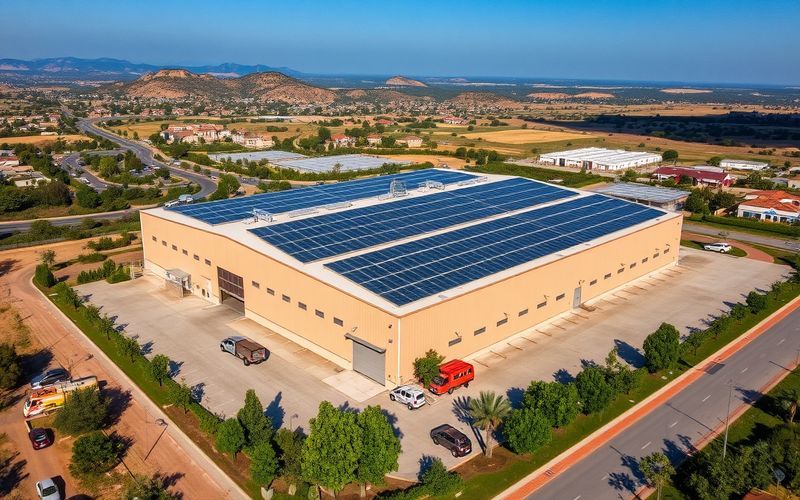
Most commercial and industrial buildings in Malta feature flat roofs, which are ideal for solar installations. Flat roof mounting offers several advantages:
- Optimal tilt angle: Panels are mounted on ballasted or mechanically fixed frames at 10–30 degrees, optimised for Malta's latitude (35.9°N)
- Flexible layout: Panels can be oriented and spaced to maximise energy production while accounting for inter-row shading
- Non-penetrating options: Ballasted mounting systems avoid drilling into the roof membrane, preserving waterproofing integrity
- Easy maintenance access: Flat roofs provide safe and convenient access for cleaning and inspections
- Dual benefit: Solar panels provide shade to the roof, reducing building heat gain and air conditioning costs in Malta's hot summers
The Self-Consumption Model
For commercial installations in Malta, self-consumption — using the solar electricity you generate directly in your business — delivers the best financial returns:
- Maximum savings: Every kWh you generate and use replaces a kWh purchased from the grid at the commercial electricity rate
- No export limitations: By sizing the system to match your daytime consumption, you minimise excess generation and maximise ROI
- Demand charge reduction: Solar generation can help reduce peak demand charges on commercial electricity tariffs
- Energy independence: Reduce your exposure to electricity price volatility and future rate increases
Energy Audit First
Before sizing your commercial solar system, conduct a thorough energy audit. Understanding your load profile — when and how you consume electricity — is essential for designing a system that maximises self-consumption and delivers the best ROI.
Power Purchase Agreements (PPAs)
A PPA offers businesses a way to benefit from solar energy without the upfront capital investment:
- How it works: A third-party investor installs, owns, and maintains the solar system on your roof. You purchase the electricity it generates at a pre-agreed rate, typically below the grid tariff.
- Zero upfront cost: The investor covers all installation and equipment costs
- Predictable energy costs: Fixed or inflation-linked pricing for the duration of the contract (typically 15–25 years)
- No maintenance responsibility: The PPA provider handles all system maintenance
- Risk-free: If the system underperforms, you only pay for the electricity actually delivered
Commercial Incentive Schemes
Businesses cannot apply for the REWS household grant, and there is no REWS grant for commercial PV. The main routes are:
- Feed-in tariff: Systems under 40 kWp can receive €0.15/kWh for 20 years (the 2026 rate, for systems without a grant), paid on the electricity exported to the grid
- Competitive tenders: Systems of 40 kW and above bid for a 20-year contract. The 2026 ceiling is €0.14/kWh
- Investment aid: Malta Enterprise runs a Smart & Sustainable Investment Grant (50% of eligible costs up to €100,000, with a 30 November 2026 deadline on the Malta Enterprise page, but sources conflict on the closing date, so confirm it with Malta Enterprise). It does not name solar PV, so check whether your project qualifies
- Tax: solar equipment used in a business may qualify for the standard wear and tear allowance on plant and machinery. We found no special accelerated allowance for solar, so check the category and period with your accountant
Visit our government incentives page for the latest information on available schemes and how to apply.
Case Studies: Commercial Solar in Malta
Hotel & Hospitality
A 4-star hotel in St Julian's installed a 75kWp system across its flat roof, generating approximately 120,000 kWh per year. With high daytime energy consumption for air conditioning, kitchens, and common areas, the hotel achieves over 85% self-consumption. Annual electricity savings exceed €18,000, with the system projected to pay for itself within 4 years.
Manufacturing Facility
A plastics manufacturing plant in the industrial estate at Hal Far deployed a 200kWp system on its 1,200 m² warehouse roof. The system generates over 320,000 kWh annually, offsetting roughly 35% of the factory's total electricity demand. With energy costs being a major operating expense, the investment delivered payback within 3.5 years.
Warehouse & Logistics
A logistics company installed a 120kWp system across its distribution centre roof, paired with a battery storage system for demand management. The combination of solar generation and peak-shaving reduced their electricity costs by over 40%, with particular savings on demand charges during peak tariff periods.
ROI for Businesses: 3–5 Year Payback
Commercial solar installations in Malta typically achieve payback in 3–5 years, thanks to high electricity rates, excellent solar irradiance, and the feed-in tariff or tender contracts. After payback, businesses enjoy 20+ years of significantly reduced energy costs.
Tax Treatment for Businesses
Beyond direct energy savings, tax can also work in a business's favour. Confirm the details with your accountant:
- Wear and tear: Article 14(1)(f) of the Income Tax Act allows a deduction for wear and tear on plant and machinery used to produce income, spread straight-line over a prescribed period. PwC lists a minimum of 6 years for equipment mainly used to produce electricity, but we could not confirm how a PV system is classified. Total allowances cannot exceed the cost of the asset
- VAT recovery: VAT-registered businesses can typically reclaim the VAT on the solar installation
- ESG reporting: Solar adoption strengthens your Environmental, Social, and Governance credentials, increasingly valued by investors, partners, and customers