Offshore Solar & Wind Energy — Malta's Marine Renewable Potential
Surrounded by the Mediterranean Sea, Malta has vast marine territory that could host offshore wind turbines and floating solar arrays. While still in early stages, offshore renewables represent a transformative opportunity for a land-scarce island nation.
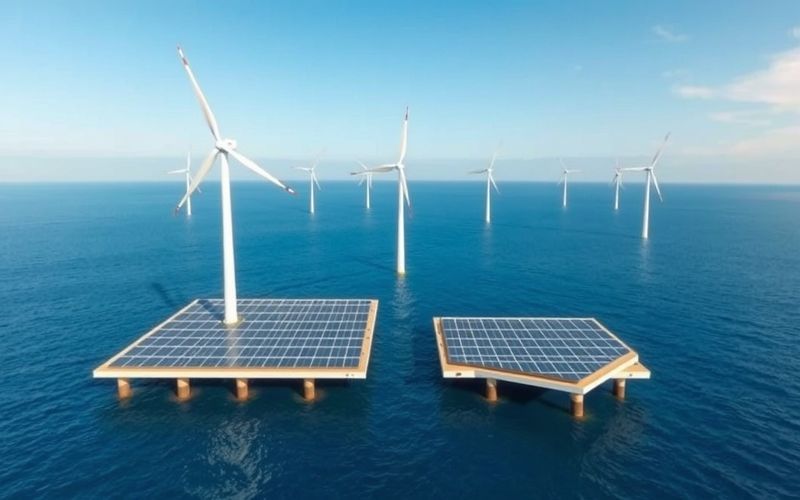
Offshore Wind Potential in Malta's Waters
Malta's maritime territory extends far beyond its tiny land area, with an Exclusive Economic Zone (EEZ) and search-and-rescue zone covering thousands of square kilometres of the central Mediterranean. This marine space offers theoretical potential for offshore wind energy development, though the practical challenges are considerable.
Wind Resource Assessment
Wind speeds in Malta's offshore waters are moderate by northern European standards, which resource measurement campaigns are still characterising. While this is lower than at prime North Sea sites, it is expected to be sufficient for modern large-rotor turbines to operate economically, particularly as turbine technology continues to improve efficiency at lower wind speeds.
The prevailing north-westerly (Maestral) and north-easterly (Gregale) winds provide relatively consistent seasonal patterns, with stronger winds during autumn and winter months complementing solar generation, which peaks in summer. This natural seasonal complementarity makes offshore wind an attractive partner to Malta's solar-dominant renewable energy mix.
Seabed Conditions and Depth
A major challenge for offshore wind development around Malta is water depth. Unlike the shallow North Sea (typically 20–50 m), the Mediterranean seabed around Malta drops steeply, often exceeding 100–200 m within a few kilometres of the coast. This rules out conventional fixed-bottom wind turbine foundations (monopiles, jackets) that are economical only in depths up to approximately 60 m.
Instead, Malta would need to rely on floating wind turbine technology — platforms anchored to the seabed by mooring lines that allow turbines to operate in deep water. While floating wind is a proven technology with several pilot and pre-commercial projects operational in Europe (including the Hywind Scotland project and installations off Portugal and France), it remains significantly more expensive than fixed-bottom offshore wind.

Floating Solar Technology
Floating photovoltaics (FPV) for marine environments represent an emerging technology that could be particularly relevant to Malta. Unlike inland floating solar on reservoirs and lakes (already proven globally), marine floating solar must contend with waves, salt spray, currents, and storms.
Several European companies and research consortia are developing marine-grade floating solar platforms designed for Mediterranean conditions. Key design features include:
- Wave-resistant structures: Flexible or semi-rigid platforms that absorb wave energy rather than fighting it, reducing structural fatigue and maintenance needs.
- Corrosion-resistant materials: Marine-grade aluminium, stainless steel, and specialised polymers that withstand salt water exposure over 25+ year lifespans.
- Anti-fouling systems: Coatings and designs that minimise marine organism attachment to submerged components.
- Secure mooring: Anchoring systems adapted to Mediterranean seabed conditions, allowing platforms to ride out seasonal storms while maintaining position.
For Malta, nearshore floating solar in sheltered bays, harbour areas, and between the islands could provide sites with reduced wave exposure compared to open sea conditions. The channel between Malta and Gozo, for example, offers relatively sheltered waters that could potentially host pilot installations.

Mediterranean-Specific Challenges
Developing offshore renewables in the Mediterranean presents a distinct set of challenges compared to the North Sea and Atlantic environments where most European offshore experience has been gained.
Depth and Bathymetry
The Mediterranean is a deep, enclosed sea. Around Malta, the seabed drops to depths of hundreds of metres within a short distance of the coast. This makes the entire region unsuitable for fixed-bottom structures and dependent on more expensive floating technology. The steep bathymetric gradient also complicates cable routing from offshore installations to onshore grid connections.
Shipping and Navigation
The central Mediterranean is one of the world's busiest maritime corridors, with dense commercial shipping traffic between the Suez Canal, North Africa, and southern European ports. Malta's strategic location means that any offshore renewable development must avoid interference with established shipping lanes, anchorage areas, and port approaches. The Malta Freeport at Marsaxlokk is one of the Mediterranean's major transhipment hubs, adding further navigational constraints.
Fisheries and Aquaculture
Malta's fishing industry, while small by European standards, is culturally and economically important. Offshore renewable installations must be planned to minimise conflicts with fishing grounds, particularly for trawling operations. Conversely, offshore structures can create artificial reef effects that attract marine life, potentially benefiting some fishing methods while displacing others.
Malta also has a growing offshore aquaculture sector (primarily bluefin tuna ranching and sea bass/sea bream farming). Co-location of aquaculture and offshore energy is an area of active research, but spatial planning must carefully balance these competing marine uses.
Tourism and Visual Impact
Tourism is a cornerstone of Malta's economy, and the visual impact of offshore installations on coastal landscapes and seascapes is a sensitive issue. Any development would need to consider viewshed impacts from popular coastal areas, beaches, and heritage sites such as Valletta's waterfront.
EU Offshore Renewable Energy Strategy
The EU strategy specifically identifies the Mediterranean as an emerging basin for offshore renewables, with a focus on floating wind technology. Mediterranean EU member states including Malta, Italy, France, Spain, and Greece are expected to contribute to regional deployment targets, supported by EU funding mechanisms including the Recovery and Resilience Facility and the Innovation Fund.
For Malta, participation in the EU offshore strategy could unlock access to significant funding and technical support, while regional cooperation with Italy (through the existing Sicily interconnector) could enable shared infrastructure and cross-border offshore projects in the Sicily Channel.
Technology Readiness
The key offshore renewable technologies relevant to Malta are at different stages of commercial readiness:
| Technology | Readiness Level | Relevance to Malta |
|---|---|---|
| Fixed-bottom offshore wind | Fully commercial | Low — waters too deep |
| Floating offshore wind | Pre-commercial (pilot farms) | High — suits deep Mediterranean waters |
| Inland floating solar | Fully commercial | Medium — limited water body area |
| Marine floating solar | Early pilot stage | High — large sea area available |
| Wave energy | R&D / early pilot | Low — Mediterranean waves generally insufficient |
| Tidal energy | Early commercial (niche sites) | Very low — negligible tidal range |
Floating wind and marine floating solar are the two technologies most likely to see deployment in Malta's waters within the next decade, subject to cost reductions and successful pilot demonstrations in comparable Mediterranean environments.

Environmental Considerations
The Mediterranean Sea is a biodiversity hotspot, home to over 17,000 recorded marine species including endangered populations of Posidonia oceanica seagrass, loggerhead sea turtles, bottlenose dolphins, and various shark species. Offshore renewable energy development in Malta's waters must be carefully managed to protect marine ecosystems.
Potential Negative Impacts
- Seabed disturbance: Anchoring, cable laying, and construction activities can damage benthic habitats, particularly sensitive Posidonia seagrass meadows that are protected under EU Habitats Directive.
- Noise pollution: Pile-driving and construction noise can disturb marine mammals and fish during installation phases.
- Bird and bat collision risk: Offshore wind turbines pose a collision hazard for migratory birds, and Malta lies on a major Mediterranean flyway for migratory species travelling between Europe and Africa.
- Electromagnetic fields: Subsea power cables generate electromagnetic fields that may affect electro-sensitive marine species.
Potential Positive Impacts
- Artificial reef effect: Submerged structures attract marine organisms and can enhance local biodiversity and fish populations.
- Fishery exclusion zones: Areas around offshore installations that are closed to trawling can function as de facto marine protected areas, allowing fish stocks to recover.
- Climate change mitigation: By displacing fossil fuel generation, offshore renewables help reduce ocean acidification and warming — the greatest long-term threats to Mediterranean marine ecosystems.
Rigorous Environmental Impact Assessments (EIA) and Strategic Environmental Assessments (SEA) would be required for any offshore renewable project in Maltese waters, in compliance with EU environmental law.
Current Projects
The government launched a procurement on 5 December 2024 for Malta's first floating wind farm of about 300 MW in its exclusive economic zone, run as a competitive dialogue. Three applicants were reported (the Code Zero consortium, Atlas Med Wind and MCKEDRIK). A metocean survey tender followed in April 2026, and Budget 2027 summaries say the studies continue, alongside exploration of renewable imports from North Africa. No award or construction date has been announced.
On the solar side, a proposed 50 MW floating plant off Delimara went to public consultation in 2024. 13 proposals were received and an expert committee is evaluating them; we found no award.
Development Timeline
The phasing below is our own illustrative outline, not an official programme, and the dates and scales are not confirmed by any government source:
- 2025–2028: Feasibility studies, marine spatial planning, and wind/solar resource measurement campaigns. Potential pilot-scale floating solar installations in sheltered harbour areas.
- 2028–2032: First pilot-scale floating wind and/or marine solar demonstrations (1–10 MW scale), informed by results from comparable Mediterranean pilot projects in Italy, France, and Greece.
- 2032–2040: Pre-commercial and early commercial-scale deployment (50–200 MW), contingent on technology cost reductions and EU support mechanisms.
- 2040+: Potential for significant capacity (500+ MW) if floating technology costs decline to competitive levels and Malta's grid infrastructure (potentially including a second interconnector) can absorb large volumes of offshore generation.
Mediterranean Neighbours Leading the Way
Italy has multiple floating wind pilot projects planned off Sicily and Sardinia. France has commercial floating wind farms under development off the Mediterranean coast. Greece has completed extensive offshore wind resource mapping. Malta can learn from these larger neighbours while pursuing development at a scale proportionate to its smaller grid and economy.